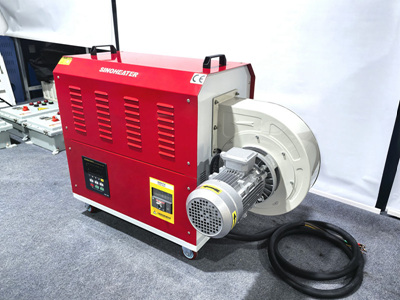
Precision Heating with Directional Airflow in Hot Air Blowers
In industrial and commercial environments, achieving uniform temperature distribution while minimizing energy waste remains a critical challenge. Hot air blowers equipped with directional airflow systems offer a solution by enabling precise control over heat delivery to specific zones. This approach not only enhances operational efficiency but also reduces heating costs in large spaces such as warehouses, manufacturing floors, and exhibition halls.
Understanding Directional Airflow Mechanics
Directional airflow systems rely on specialized nozzle designs to guide heated air toward targeted areas. Unlike traditional diffusers that disperse heat uniformly, these nozzles create focused streams of warm air with minimal turbulence. The key principle involves optimizing the velocity and angle of air discharge to counteract natural heat stratification—a phenomenon where warm air rises and cold air settles near the floor.
By adjusting the nozzle geometry, engineers can control the throw distance and spread of heated air. For instance, a narrow-angle nozzle generates a concentrated jet suitable for heating distant zones, while a wide-angle nozzle distributes heat across broader areas. This adaptability makes directional systems ideal for spaces with irregular layouts or varying thermal demands.
Applications in High-Ceiling Environments
In large venues like sports arenas or aircraft hangars, maintaining consistent temperatures across vast volumes is challenging. Directional hot air blowers address this by directing heat downward to counteract cold air pooling near the floor. This method reduces the need for supplementary heating systems and ensures occupant comfort without overheating upper levels.
A practical example involves heating a multi-story exhibition hall. By positioning directional blowers along the perimeter walls, operators can create a curtain of warm air that prevents cold drafts from entering occupied zones. This strategy minimizes heat loss through open doorways or large windows while maintaining a stable indoor climate.
Enhancing Energy Efficiency Through Zonal Control
One of the primary advantages of directional airflow is its ability to implement zonal heating strategies. By dividing a space into thermal zones and assigning dedicated blowers to each area, facilities can adjust heating output based on occupancy or usage patterns. For example, a manufacturing plant might reduce heat supply to storage zones during off-hours while maintaining optimal temperatures in production areas.
This granular control also reduces energy waste by avoiding overheating unoccupied spaces. Studies indicate that zonal heating systems can cut energy consumption by up to 30% compared to conventional whole-space heating methods. Additionally, directional blowers often incorporate variable-speed drives that adjust airflow rates in response to real-time temperature feedback, further optimizing efficiency.
Overcoming Challenges in Implementation
Despite their benefits, directional airflow systems require careful planning to avoid common pitfalls. One issue involves airflow interference from structural elements like beams or partitions, which can disrupt the intended heat distribution pattern. To mitigate this, engineers use computational fluid dynamics (CFD) simulations to model airflow behavior and identify potential obstacles before installation.
Another challenge is maintaining airflow balance across multiple blowers operating in tandem. Uneven discharge velocities can create hot or cold spots, undermining the system’s precision. Regular calibration of nozzle settings and airflow sensors ensures consistent performance over time.
Finally, noise generation from high-velocity air discharge may pose concerns in noise-sensitive environments. Modern directional blowers address this by incorporating aerodynamic nozzle designs and sound-dampening materials to minimize operational noise without compromising heating efficiency.
Future Innovations in Directional Heating Technology
Advancements in sensor technology and artificial intelligence are driving the next generation of directional hot air blowers. Smart systems now integrate occupancy sensors and machine learning algorithms to predict heating demands and adjust airflow patterns dynamically. For example, a blower might increase output to a conference room 15 minutes before a scheduled meeting based on historical usage data.
Another emerging trend involves hybrid systems that combine directional airflow with radiant heating elements. By coupling forced-air convection with infrared radiation, these systems provide both immediate warmth and long-lasting heat retention, making them suitable for spaces with rapid temperature fluctuations.
As sustainability becomes a priority, manufacturers are also exploring renewable energy integration. Solar-powered directional blowers and heat recovery systems that capture waste heat from industrial processes are gaining traction, offering eco-friendly alternatives to traditional fossil fuel-based heating solutions.
By leveraging directional airflow technology, facilities can achieve unprecedented precision in thermal management. From reducing energy waste to enhancing occupant comfort, the benefits of these systems extend across industries, making them a cornerstone of modern heating strategies. As innovation continues, the next decade promises even more sophisticated solutions tailored to the evolving needs of smart buildings and sustainable infrastructure.