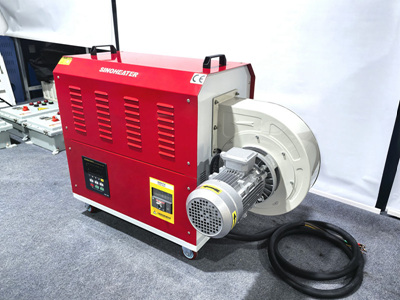
Vibration Impact Inspection for Heat Blowers After Use Near Railway Lines
Common Sources of Vibration from Railway Operations
Railway lines generate persistent vibrations through multiple mechanisms, primarily from passing trains and track maintenance activities. When a heat blower operates near these lines, these vibrations can propagate through the ground or air, affecting its structural integrity and performance. For instance, freight trains carrying heavy loads produce low-frequency vibrations (typically below 50 Hz) that travel long distances through soil and concrete foundations. In a logistics hub, a heat blower installed 50 meters from a freight line experienced erratic motor operation due to resonance with these vibrations, leading to premature bearing wear.
Track maintenance equipment, such as ballast tampers or rail grinders, also contribute to high-frequency vibrations (above 100 Hz) during operation. These vibrations are more localized but can cause immediate damage to nearby equipment if unmitigated. A construction site near a railway reported heater malfunctions after daily tamping activities, traced to loose fasteners on the heater’s mounting brackets caused by repeated impacts. Additionally, natural factors like soil type and moisture content influence vibration transmission—soft, damp soils absorb more energy, while rocky or dry terrain amplifies vibrations, increasing risks to heat blowers.
Critical Components Vulnerable to Vibration Damage
Mechanical Mounting Systems
Heat blowers rely on mounting brackets, bolts, and vibration isolators to secure them to floors or walls. Prolonged exposure to railway vibrations can loosen these components, leading to misalignment or detachment. For example, a manufacturing plant observed a heater shifting 2 cm from its original position after six months near a commuter rail line, caused by fatigue in its mounting bolts. During inspection, check for cracks in brackets, stripped threads on bolts, or deformation in vibration isolators (e.g., rubber mounts or spring dampers). A food processing facility resolved similar issues by upgrading to high-tensile bolts and adding secondary locking mechanisms.
Rotating Machinery and Bearings
Motors, fans, and impellers in heat blowers are susceptible to vibration-induced wear, especially if their rotational frequencies align with railway vibration harmonics. A paper mill reported a 30% increase in motor bearing failures after relocating a heater closer to a freight yard, attributed to resonant vibrations accelerating lubricant degradation. Inspect bearings for signs of pitting, scoring, or excessive play, which indicate vibration damage. Use a stethoscope or vibration analyzer to detect unusual noises or vibrations in rotating parts, focusing on frequencies matching train-induced oscillations (e.g., 10–20 Hz for freight trains).
Electrical and Control Components
Vibrations can also disrupt electrical connections and control circuitry in heat blowers. Loose wiring terminals or solder joints may cause intermittent faults, such as sensor errors or power disruptions. In a chemical plant, a heater’s temperature controller failed intermittently due to vibrations loosening its PCB connections, resolved by securing components with adhesive-backed mounts. Check for frayed insulation, corroded terminals, or displaced relays during inspection. Additionally, verify that control panels are properly grounded, as vibrations can induce electrical noise in unshielded systems, leading to malfunctions.
Step-by-Step Vibration Impact Inspection Procedures
Visual and Physical Assessment of Mounting Structures
Begin by examining the heat blower’s mounting system for visible signs of stress. Look for cracks in brackets, bent fasteners, or misaligned components, which may indicate excessive vibration exposure. Use a flashlight to inspect hard-to-reach areas, such as the underside of mounting plates or behind control panels. For example, a warehouse near a railway found that vibrations had caused a heater’s mounting bracket to fracture at a weld joint, requiring immediate replacement. Document any damage and prioritize repairs, such as reinforcing brackets with gussets or replacing worn isolators.
Next, check the stability of the heater’s position by measuring its alignment with reference points, such as floor markings or adjacent equipment. A 1–2 mm deviation may seem minor but can escalate into severe misalignment over time, affecting airflow or motor efficiency. In a automotive plant, a heater’s misalignment due to vibrations reduced its heating capacity by 15%, corrected by realigning it with shims. Use a spirit level or laser alignment tool to ensure the heater sits level and plumb.
Vibration Measurement and Analysis
Deploy vibration sensors (e.g., accelerometers) on the heat blower’s motor, fan housing, and mounting points to quantify vibration levels. Collect data over multiple train passages to capture peak amplitudes and frequencies. Compare readings to industry standards like ISO 10816, which defines acceptable vibration limits for rotating machinery. For instance, a heater near a high-speed rail line recorded peak vibrations of 8 mm/s at 15 Hz, exceeding the 5 mm/s threshold for safe operation, prompting the addition of vibration dampers.
Analyze frequency spectra to identify dominant vibration modes. If railway vibrations (e.g., 10–20 Hz for freight trains) overlap with the heater’s natural frequencies (e.g., motor rotational speed), resonance can amplify damage risks. A mining operation used this approach to discover that a heater’s motor was operating at a resonant frequency with train vibrations, resolved by adjusting the motor speed or adding mass dampers to shift the natural frequency.
Component-Specific Checks and Maintenance
Inspect rotating machinery for signs of vibration-induced wear. Manually rotate motors and fans to check for rough operation or unusual noises, which may indicate bearing damage. Use a borescope to examine internal components if disassembly is impractical. In a textile plant, a heater’s fan impeller showed cracks at the hub due to vibrations, replaced with a reinforced design to prevent recurrence. Lubricate bearings according to manufacturer guidelines, using high-viscosity grease for high-vibration environments.
Verify electrical connections for tightness and integrity. Use a torque wrench to retighten terminals to specified values, ensuring no loose wires remain. Check for chafing or insulation damage on cables routed near vibrating surfaces, such as motor housings or ductwork. A power plant resolved intermittent heater faults by rerouting cables away from vibration sources and adding cable clamps to prevent movement.
By following these procedures, heat blowers can withstand vibration impacts from nearby railway lines, ensuring long-term reliability and safety in industrial settings.